

P.O. Silvagni
The Godfather of
Las Vegas
The true and untold history of Las Vegas, its hidden decade, and the man who started it all.
By Gina Silvagni Perry
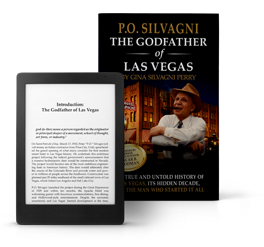
Now Available!
THE GODFATHER OF LAS VEGAS
The true and untold history of Las Vegas, its hidden decade, and the man who started it all.
The Godfather of Las Vegas
People are fascinated by Las Vegas. Why wouldn’t they be? It is one of the most exciting and famous cities in the world. It has everything.
But how did it all begin? How did this small desert outpost become the entertainment and hospitality capital of the world?
When Las Vegas was founded, little existed beyond a handful of natural springs. Nothing suggested that this remote settlement in the Mojave Desert would one day become an international destination.
Most people believe the mob created Las Vegas. Others credit Benny Binion and the Horseshoe Club. Neither is true.
It was a 60-year-old Italian immigrant, P. O. Silvagni, who arrived in Las Vegas during the Great Depression and forever changed the city’s trajectory. Yet, for nearly a century, one of the most important chapters in Las Vegas history—and the man at its center—has remained largely forgotten.
Drawing on extensive historical documentation, this compelling biography uncovers the true story of the man who helped lay the foundation of modern Las Vegas with his own hands. His vision, determination, and leadership transformed a struggling railroad town into a city destined for worldwide recognition and enduring prosperity.
Meet the man. Discover the history. Decide for yourself why P. O. Silvagni is The Godfather of Las Vegas.
More About Gina Silvagni Perry
Born into one of the families that helped shape early Las Vegas, Gina Silvagni Perry uncovers the remarkable story of her grandfather, Peter “P.O.” Silvagni, builder of the historic Apache Hotel on the corner of Second and Fremont Street. From tragedy and hardship in Italy, his immigration to the United States, his willingness to start at the rock bottom of a coal mine in Colorado, to success in Utah, and a risky gamble that paid off handsomely in Las Vegas during the Great Depression of 1929, his journey is a powerful story of resilience, ambition, and the American Dream. Through years of research, Gina brings a forgotten pioneer, a hidden decade, and an important chapter of Las Vegas history, back into the spotlight.

New eBook Available
READ IT ON THE GO
The untold story of Las Vegas is now just a click away. Discover the man who helped build modern Las Vegas. Read the eBook today.
New eBook Available
READ IT ON THE GO
The untold story of Las Vegas is now just a click away. Discover the man who helped build modern Las Vegas. Read the eBook today.
A Look Inside The Godfather of Las Vegas
Introduction:
The Godfather of Las Vegas
god-fa-ther; noun: a person regarded as the originator or principal shaper of a movement, school of thought, art form, or industry.
On Saint Patrick’s Day, March 17, 1932, Peter “P.O.” Silvagni (sil-vah-knee), an Italian contractor from Price City, Utah, spearheaded the grand opening of what many consider the first modern resort hotel in Las Vegas history. He undertook this ambitious project following the federal government’s announcement that a massive hydroelectric dam would be constructed in Nevada. The project would become one of the most ambitious engineering feats in American history. The dam would ultimately alter the course of the Colorado River and provide water and power to millions of people across the Southwest. Construction was planned just 25 miles southeast of the small railroad town of Las Vegas, which linked Los Angeles and Salt Lake City.
P.O. Silvagni launched the project during the Great Depression of 1929 and within ten months, the Apache Hotel was welcoming guests with luxurious accommodations, fine dining, and Hollywood-style entertainment. Despite the economic uncertainty and Las Vegas’ limited development at the time, his vision became the Apache Hotel. Today, it still stands at the northwest corner of Second and Fremont Street, honoring the history of Fremont Street and Downtown Las Vegas.
New business opportunities were scarce during the Great Depression, but P.O. – the two-letter acronym for Pietro Ottavio’s vowel-packed name – wasn’t going to let a nationwide economic collapse slow him down; he was out prospecting the country looking for the next big thing. After traveling throughout the western United States, P.O.—who throughout this book is also referred to as Pete, Peter, Ottavio, and occasionally Ottaviano—arrived in the young southwestern city of Las Vegas. No one else could see it, but something there caught his eye. He saw opportunity sparkling in the sands of the Mojave Desert where others saw only dust and uncertainty.
Las Vegas was positioned along a key Union Pacific Rail stop and the new Arrowhead Trails Highway that connected Utah to California. With abundant water resources, a strategic location, and the tallest arch gravity dam ever constructed in North America preparing to commence, the city was on a path for explosive growth.
P.O. saw that Las Vegas was about to become a national tourism hot spot although it had little to welcome the tourist trade traveling nationwide to see it. Las Vegas was missing something elemental to its success, and in its absence, the city’s progress would be thwarted. Las Vegas faced a glaring lack of modern, comfortable hotel rooms. Without welcoming accommodations, Las Vegas would be unable to host the flow of national tourism expected to come from the dam’s construction.
P.O. quickly recognized the opportunity before him and it compelled him to act. He bought a prime downtown business corner and took it upon himself to deliver the city a world-class resort hotel in under ten months.
The Apache Hotel, named to honor the fiercest fighting of American Indian tribes, reflected the era’s fascination with the American Southwest and how it influenced modern architectural design. The new hotel represented a level of sophistication Las Vegas had never before experienced. It featured the finest in luxury amenities and the latest in modern conveniences. Additionally, the hotel was designed to withstand the challenges of Las Vegas’ sometimes unforgiving desert climate.
Realizing that his window of opportunity was going to close if action was not taken quickly, expert builder Peter “P.O.” Silvagni knew he could create something beautiful and necessary to empower Las Vegas’ new industry: tourism and hospitality. On the mother of all Las Vegas business corners, he built a hotel that transformed a city, changed its trajectory, and shaped its future. When the Apache Hotel opened its doors, it immediately became the core of Las Vegas and the hub of all business and social activity for nearly a decade.
This book is the true story of an Italian immigrant, a coal miner, a contractor, and an engineer. It chronicles the life of a gifted builder and a fearless entrepreneurial visionary, who at 60 years old, traveled to Las Vegas searching for work during the Great Depression of 1929. Although the country’s economy was in shambles when he arrived, and he never found the employment he sought, P.O. found instead the once-in-a-lifetime opportunity to meet Las Vegas’ growing tourism needs.
Despite P.O.’s many contributions to the city’s early development, his role in Las Vegas history gradually faded from public memory. Many people came to Las Vegas promising ambitious developments, but none followed through with their promises. It was outsider Peter Silvagni who accomplished what no one else could. Although he risked everything he had for a struggling city with limited prospects for a certain future, P.O.’s contributions were largely omitted from the story he began—until now.
Chapter One
The Big Bang
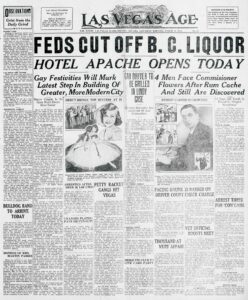 “HOTEL APACHE OPENS TODAY”
“Gay Festivities Will Mark Latest Step In Building Of Greater, More Modern City”
Las Vegas Age, March 17, 1932
“Mayor E.W. Cragin will throw open the doors of the new Hotel Apache at five o’clock this afternoon, heralding the gala presentation for service of the traveling public, and the start of one of the most elaborate premier showings ever held in Las Vegas.”
The front page gushes over the “beautiful new Apache Hotel,” installed with “hostelry furnishings that beggar description,” featuring “hand-carved divans and armchairs randomly placed over deep carpets that cover the floor of the lobby,” and “great windows” framed by “rich drapes that inspire awe.” The front page describes an “artistic mezzanine” presiding over a “lofty ceilinged lobby” that displayed “rich colored oil paintings that give life to the walls.” The artwork was illuminated by “bizarre chandeliers that touch a stirring note.” The writer praises the “infinite care” that had been taken of “60 new rooms steeped in the color of the old west,” “lavishly furnished” with “up to the minute conveniences” including an “electric elevator” that transported each guest to “wide carpeted hallways,” greeting each one with “instant refreshment” from the “electrically cooled drinking fountains” located on every level. The writer extols the equipment installed to operate the kitchen that “is strictly modern, sanitary, and efficient, from the sterilizing electric dishwasher to the lift operating from the kitchen to the dining room on the floor below,” and that the “coffee shop and café are as lavishly furnished as the rest of the beautiful new Apache Hotel.”
“We may rest assured that the food will be in keeping with the high requirements of the best hotels of the country, and the service is such as to make dining there not simply the satisfying of hunger but a pleasant rite of bringing both physical and mental enjoyment. To make the whole perfect, dance and concert music of a high order will always be provided.”
In 1932, Las Vegas lacked many basic amenities and visiting the city meant relinquishing the creature comforts travelers expect when they book a hotel stay. The reputation that Las Vegas was primitive and an unpleasant place to visit preceded tourism plans for potential visitors. All of that changed, however, when a builder from Utah rolled into town looking for work but was instead struck with the staggering revelation that Las Vegas deserved nice things. Pete Silvagni realized that Las Vegas needed a grand hotel with modern amenities to support the tourism industry beginning to emerge around the Boulder Canyon Project.
“THE AGE would like to express in full the sense of appreciation which Las Vegas holds for those who have been instrumental in creating that splendid new Hotel Apache. To P.O. Silvagni, whose initial enterprise the splendid building which houses the hostelry is due, we express a deep appreciation. To him came the inspiration for the great enterprise, and to his untiring efforts and through the investment of large capital, the beautiful building was constructed, complete and fine in all details and perfectly adapted to the purpose for which it was designed.”
Front-page news described the Apache Hotel as a state-of-the-art masterpiece, marking its opening as a momentous event for Las Vegas. History shows that the Apache’s presence was a vital factor underpinning the expansion of Las Vegas’ gaming, entertainment, and hospitality industries for more than 10 years. Over time, many accounts of Las Vegas history gave comparatively little attention to the city’s formative years during the 1930s and the key figures and events that contributed to the city’s most pivotal decade.
Other than when the Union Pacific laid down railroad tracks in 1904, and the government approved the construction of the Boulder Canyon Project in 1928, no other development of that era created the kind of buzz, growth, and prosperity for Las Vegas as the Apache Hotel. In modern times, that kind of enthusiasm didn’t emerge until the Mirage opened on the Las Vegas Strip 60 years later. Although lavish accommodations were abundant on the Strip before 1989, Steve Wynn’s Mirage elevated the Las Vegas “hospitality experience” to a new level. Both projects marked important turning points in the evolution of Las Vegas hospitality, each making significant contributions to the city’s hospitality industry; however, P.O. Silvagni’s contribution to the city’s early hospitality industry has largely gone unrecognized.
Charles “Pop” Squires, a founding pioneer, settler, and editor of the Las Vegas Age newspaper writing under the pseudonym C.P.S., expressed that the opening of the Hotel Apache would attract hundreds of thousands of visitors drawn to the desert city’s unique offerings and its novel experiences. As someone who had been in Las Vegas since its 1905 inception, Pop Squires was often called “The Father of Las Vegas,” making him one of the prominent voices of his time.
Squires was passionate about the opening of the Apache Hotel and what it would mean to the city of Las Vegas. He wrote his ardent annotations in an editorial column titled “Observations.”
“Nothing of American scenery and surroundings has more allure than the so-called desert. It has mysterious charm and a certain strange menace, which is a challenge to every lover of the out-of-doors.
Full of the traditions of the pioneer days and the thrill of the Old California Trail, the particular region around Las Vegas adds a weird desert beauty not excelled by any portion of the Great Southwest. Which means that, with the opening of Las Vegas’ delightful Hotel Apache, seekers of the novel and striking will come in ever-increasing numbers, which will require several other great hotels to accommodate the wealthier classes and a score of the more modest ones to care for the everyday automobile tourists who will come by the hundreds of thousands every year.”
Squires comforted those who feared that the hotel would cannibalize the existing businesses in town, and he assured them that the Apache Hotel would act as a magnet to attract more business and more prosperity to everyone. To quote C.P. Squires, the desert’s mysterious allure and the opening of the Apache Hotel were catalysts to “make the best of our own,” and would attract the kind of tourism that would bring success to all of Las Vegas.
“Where on earth can one find such a great variety of scenic attractions as in the region tributary to Las Vegas? We are too apt to lose sight of our own natural resources. Only one thing could possibly have defeated our hopes-that is our lack of ambition to make the best of our own.
With the completion of Hotel Apache, that fear is past. We now have the type of attractive accommodations which serve to draw people of wealth and enterprise to us. The Apache will not be a competitor coming in to divide existing business, but a magnet to attract business, which will spell prosperity for all.”
P.O. ensured that only the best and brightest talent available would be associated with his hotel. With top-tier hotel and restaurant management, Hollywood-style entertainment, and experienced gaming operators, he could promise guests the most comfortable rooms, the finest dining and entertainment options, and an exciting and diverse gaming experience.
For the first time, Las Vegas, Nevada, a dusty western town that developed around a whistle-stop, was gaining national recognition as a destination for tourism, hospitality, and gaming. Pete Silvagni played a crucial role in shaping Las Vegas’s future, setting the stage for the Entertainment Capital of the World to emerge in the decades that followed. Silvagni set the bar so high for the latest in modern luxury amenities and technological advancements, it lifted a city rooted underneath its railroad tracks and catapulted it into worldwide fame.
Despite being an iconic and enduring presence that has housed a succession of legendary tenants – most notably, Benny Binion’s Horseshoe Club, where the World Series of Poker was inaugurated and held there from 1970 to 2005 – when the Apache Hotel turned ninety years old on March 17, 2022, the media overlooked it. Although the press and media outlets have consistently honored the anniversaries of other historical hotel and casino properties, they remained silent for this ninety year old groundbreaker. In contrast, when the El Cortez Hotel celebrated its eightieth anniversary in 2021, local newspapers and media extensively covered its historical significance with multi-page features. Yet, the first mega-resort in the history of Las Vegas, the one that helped establish the city’s early hospitality industry, received no recognition on its 90th birthday.
The following year, Las Vegas’ largest newspaper published a full-page article highlighting the city’s rich history. The article claims that the El Cortez was the first large resort hotel constructed in Downtown Las Vegas. While it may have been the largest resort when it opened in 1941, the Apache Hotel was the first, the largest, and the only resort built in Downtown Las Vegas a decade earlier. In fact, without the Apache Hotel, the El Cortez would have never come into existence. If Las Vegas had not reached its full potential during the 1930s, tourists, builders, investors, even the mob, would have paid no attention to it, let alone invested in it.
Peter Silvagni is the key figure who positioned Las Vegas to thrive during the Great Depression of 1929. While the Boulder Canyon was being blasted and drilled into an enormous dam, P.O. was investing in the future of a little railroad town twenty-five miles north of it. Had it not been for Silvagni’s gamble on the future of Las Vegas during the most significant financial crisis in history, it is impossible to say what would have happened to Las Vegas, or when.
“One bright ray shone through the clouds of the depression, however, for Las Vegas. P.O. Silvagni, a businessman from Price, Utah, saw the possibilities here and was willing to risk his money on the future of the area. From that willingness to gamble came the Apache hotel.”
On any website or in any book chronicling Las Vegas history during the 1930s, writers and historians either overlooked the era in their research or intentionally omitted it. A prominent Las Vegas newspaper currently features a historical timeline detailing significant events in Las Vegas since its discovery in 1829 by Mexican scout Raphael Rivera. Between 1930 and 1940, there was no hotel worth mentioning. What made it on the list of significant events was the “Pair-O-Dice Club,” a casino that opened in 1931 on Highway 91. The club’s exterior was a replica of a big red barn and Highway 91 was a long stretch of road that later became the Las Vegas Strip. Because the bar and casino’s location on what would one day become the Strip, the opening of the Pair-O-Dice Club in 1931 is named as the decade’s most significant event.
At the time, Highway 91 was the road to Los Angeles and the only way out of town. Its location, however, did not save the Pair-O-Dice Club from going bankrupt and closing the same year it opened. Seven years later, the same club was reopened under new management and a new name, the 91 Club. Despite the 91 Club also going belly-up, it was recognized as the second most significant gaming establishment to open during the 1930s. While the opening of the Apache Hotel in 1932 is not mentioned on the list of significant events over the decade, historians would have you believe that a twice-failed “barnino” on Highway 91 were the two most notable gaming enterprises of the 1930s.
Ironically, the demise of both clubs in the 1930s was due to their location on Highway 91. It was too far from the city’s center for residents or tourists to support it. Locals could find more action and better entertainment a few steps from their front door.
“… the residents of the community soon began to feel it was too far out,” and “it was halfway to Los Angeles in the minds of the local people.”
Neither the Pair-O-Dice nor the 91 Club could begin to compete with the Apache Bar, whose slogan, “where love meets,” sparked many happy unions. No nightclubs on Highway 91 or anywhere in Las Vegas could rival the Apache’s Kiva Club, Las Vegas’ first real nightclub. In addition to importing first-class singers and live orchestras from Hollywood, P.O. brought in comedians and other professional performers who delighted patrons every night in the full-floor, subterranean-level nightclub underneath the Apache Hotel.
From 1930 to 1940, there is no mention of the city’s first air-conditioned hotel and casino in Las Vegas. The hotel had the first elevator, was the city’s first three-story building, and was the first building in Las Vegas to have a completely waterproofed basement. The Apache Hotel also had a women’s business and recreational center, a dress shop, a beauty and barber shop, a drug store, a gift shop, a tobacco and cigar shop, and a convention center that could host and serve five hundred people in a banquet hall that had its own kitchen to service it. Other than the Apache Hotel, Las Vegas had nothing existing or under construction that could offer visitors or local residents first-class accommodations, gourmet dining, and quality entertainment many had only seen in the movies. Still, its opening in 1932 is not mentioned anywhere in Las Vegas’ historical timeline; the election of Patrick McCarran to the U.S. Senate is named as the most noteworthy event of 1932.
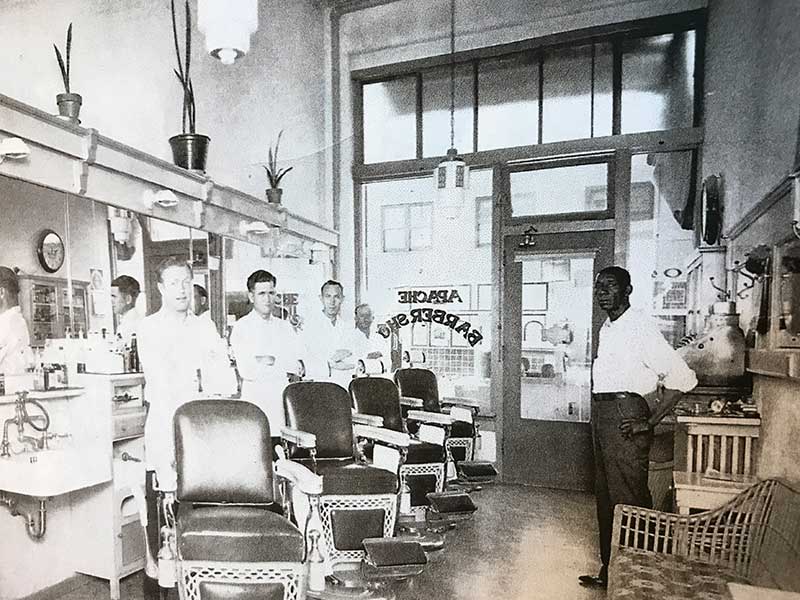
Special thanks to Raymond Potter for providing a photocopy of the Apache Barber Shop
Newspapers reported Las Vegas’ dismal prospects for its future. The city was not surviving on tourism when the dam was announced in 1928. It was gasping for its economic breath as the Great Depression took hold. At the pinnacle of America’s worst financial disaster, however, it began to thrive on tourism once the Apache Hotel opened its doors. Tourists poured into Las Vegas as soon as the Boulder Canyon Project began, bringing prosperity to everyone.
The Apache Hotel Corporation launched an intense publicity campaign to let the world know that Las Vegas was open for business and was empowered to host as many new visitors who wanted to come. Former corporate lawyer, Ila Sample, headed marketing for the national campaign and was quoted, “There is no one spot in the civilized world more in the public mind today than Boulder Dam,” Sample said. “It should be the means of bringing hundreds of thousands of persons to southern Nevada during the next six years, and our purpose is to help bring them here,” he concluded.
Bring them here they did, and once visitors had a luxury destination resort to immerse themselves in out of curiosity, they liked it. Throngs of people began coming to Las Vegas for the first time. They may have stopped by for a peek at the city after touring the dam, but they stayed for a heaping helping of its hospitality, the new industry being served at the Apache Hotel. And for much of the following decade, the Apache Hotel offered a level of entertainment and hospitality unmatched in all of Las Vegas.
Many historical accounts of Las Vegas devote extensive attention to the mob era while giving little attention to the city’s formative years. The 1930s offered newcomers and residents limitless growth opportunities of a town breathing new life. Its consistent growth sustained a strong local community that forged many great family legacies, some of which exist to this day.
Curious readers who want to know how Las Vegas truly began can only conclude that Las Vegas was frozen in time during the 1930s, lying motionless until the mob came and breathed life into it. The city adopted that premise and made it its mantra while the real historical origins of Las Vegas during the 1930s were buried.
Las Vegas did not begin because the mob infiltrated it. Boulder Dam’s construction and the opening of the Apache Hotel was the watershed for Las Vegas to prosper. Organized crime figures were drawn to Las Vegas because they saw enormous financial opportunity in a wide-open city with legal gambling and limited oversight over everything else. Their influence expanded through political connections, financial incentives, and weak regulatory systems that allowed corruption to flourish. As the gaming industry grew, mob figures recognized the enormous profits that could be skimmed from casino operations and moved quickly to secure their place within the city’s emerging power structure.
For decades, famous book authors and film producers have parlayed the glamour of the mob into hundreds of millions of dollars. They glorified the mob’s lifestyle flush with cash, their wives and their mistresses, and their fierce loyalty to the “omerta,” the Mafia’s sacred vow of silence. The mob was extolled for their unique ability to separate their family lives from the violence and corruption that membership into a criminal organization often demanded. Blockbuster movie franchises exploited the mob’s intriguing and sexy narrative, capturing the attention of everyone, including the City of Las Vegas. Although they were almost nowhere to be found during the 1930s, from 1941 until the Gaming Control Board was established in 1955, mobsters were allowed to operate unrestrained within the local and state legal systems.
Las Vegas’ course with destiny would have been diverted if the Apache Hotel hadn’t been built during the construction days of the dam. Las Vegas could have remained what it was, a rundown railroad town struggling to stay alive. Boulder City, anchored by the largest arch-gravity dam in the United States, could have become the hot new growth city in the Southwest. Within ten months, however, the Apache Hotel was hosting hundreds of tourists, government bigwigs, heads-of-state, movie stars, and even royalty. Instead of historians chronicling the events that made Las Vegas famous and prosperous, they surrendered the city’s fundamental growth decade to Murder Incorporated.
The overwhelming vision that prompted P.O. to jump-start Las Vegas set the city on its course toward worldwide fame and popularity few could imagine. Built for the long-term growth of Las Vegas, the Apache Hotel was more than enough to cradle and carry Las Vegas for the next ten years. The El Cortez Hotel opened in 1941, the Golden Nugget came in 1946, the Fremont Hotel in 1956, and the Four Queens in 1966. It took more than thirty years from the opening of the Apache Hotel for the remaining four corners of Fremont Street to be completed. When it was, the cross-streets of Second and Fremont became the most famous and the most recognizable four corners in Downtown Las Vegas history.
This book is a chronicle of his-story and P.O. Silvagni’s contributions to Las Vegas from the early 1930s. The historians missed it, and what wasn’t missed was either misspelled, misrepresented, or marginalized. It was not until a historical docuseries, “Las Vegas, The Early Years-The Thirties,” was released for streaming on the YouTube Channel, that the Apache Hotel and P.O. Silvagni were recognized as part of Las Vegas history. The series, funded by the City of Las Vegas and produced by Boyd Productions of New York City, marked the first time the Apache Hotel and P.O. Silvagni were given the spotlight in a brief interview with one of P.O.’s living granddaughters.
Let history show that before the rise of the Las Vegas Strip, before Bugsy Siegel opened the El Cortez and the mob infiltrated Las Vegas; before Benny Binion’s Horseshoe Club and the inauguration of the World Series of Poker, and before all the legends who created the mystique that has made Las Vegas one of the most famous cities in the world, there was a beginning and a core, and the core revolved around the corner of Second and Fremont Streets in Downtown Las Vegas, where the social and economic epicenter of Las Vegas was born.
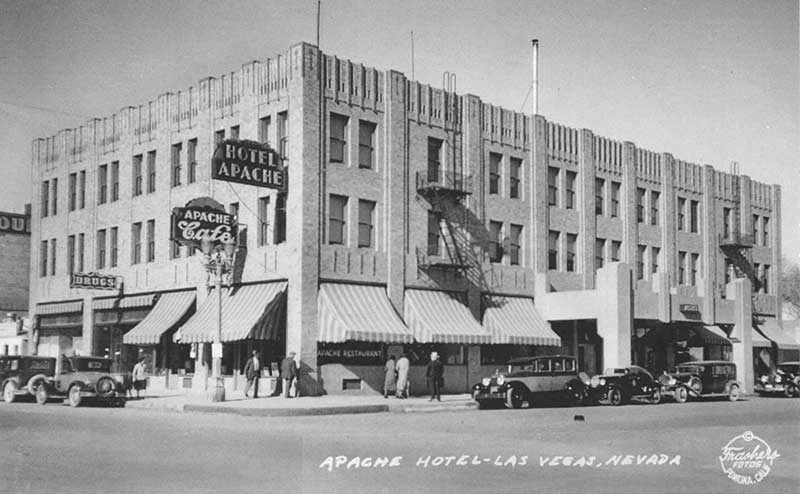
Photo Courtesy of Frashers Foto Collection / HJG, with special thanks to Mr. Henry Golas
“In the history of Las Vegas, Silvagni must go down as the man who revived the spirits of a desperate community at a critical period and went on to become another of the great pioneers who laid the foundation for today’s great city.”